Lawn care
Dethatching vs Aeration: Which Does Your Lawn Need?
By Lawn & Loam Editorial DeskPublished 2026-08-156 min read
Two similar-sounding fixes, dethatching and aeration, get conflated constantly, but they solve different problems. Dethatching removes a thick organic mat; aeration relieves compacted soil. The page shows how to tell which problem your lawn actually has, what each process does, and how to run the right tool without wrecking the turf.
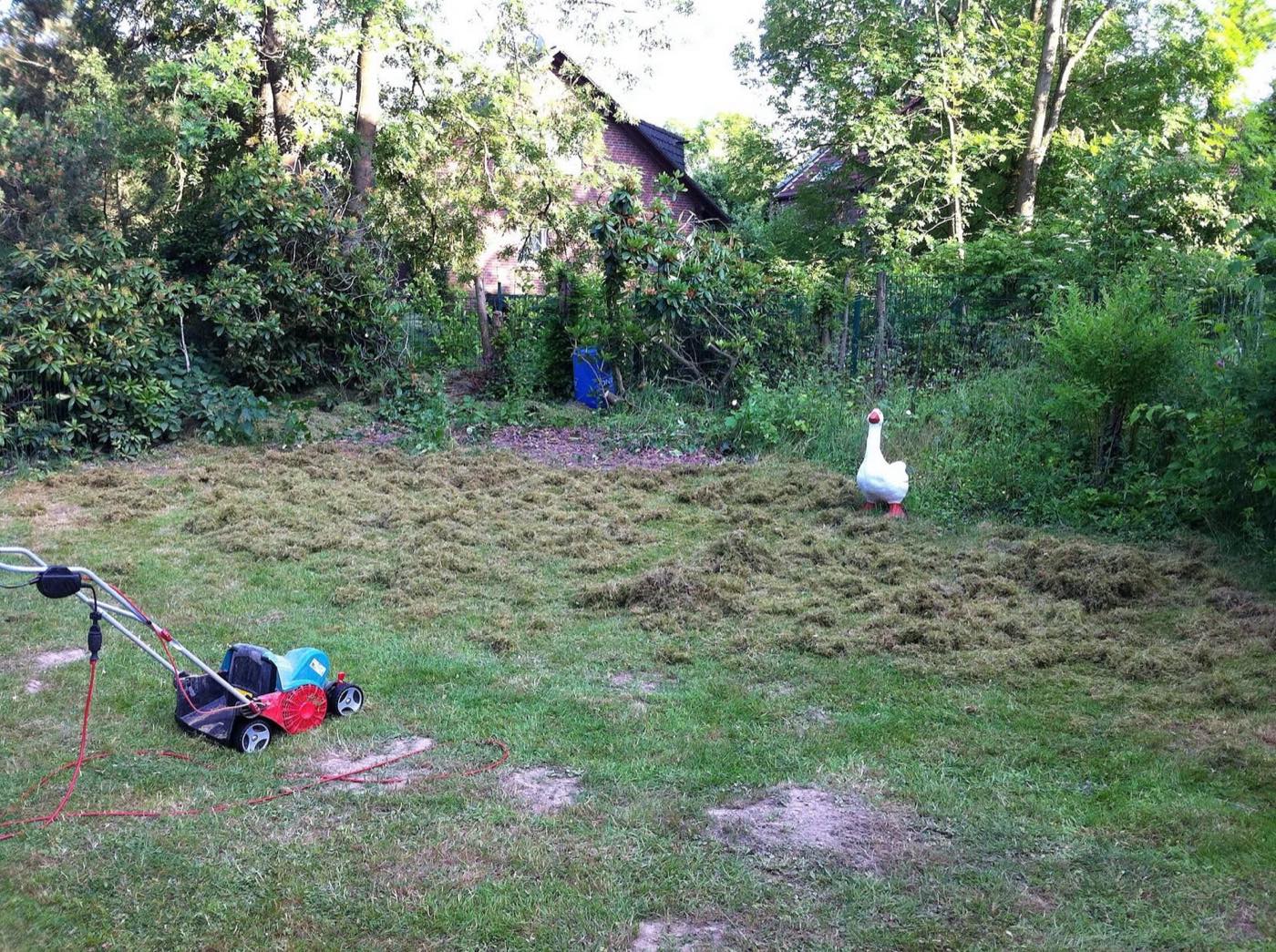
Image source: File:Vertikutierer in einem Garten.jpg · CC via Wikimedia Commons
What thatch is, and when it is a problem
Thatch is the layer of living and dead stems, roots, and runners between the green growth and the soil surface. Both Wisconsin's and Illinois's extension programs note that thatch is often misunderstood: some lawns manage theirs naturally, while others accumulate a chronic layer.
Thatch becomes a problem when it gets thick enough to block water and air from reaching the soil. To check, cut a small plug and look at the cross-section: a thick, springy mat with a dense brown layer under the grass is thatch. A lawn that feels like a sponge and roots shallowly is the classic picture.
- Thatch = the organic layer between grass and soil.
- Thin thatch is normal; thick thatch blocks water and air.
- Check with a small plug or by pressing the turf.
When dethatching is the fix
Dethatching, power raking or vertical mowing, physically cuts and pulls out the mat. Rental machines handle most lawns; small areas can be raked by hand, slowly. Run the machine in shallow passes in more than one direction rather than digging one deep pass that chews up the lawn.
Timing matters more than technique: cool-season lawns recover best when dethatched in early fall or spring, never during summer stress, and warm-season grasses have their own windows, confirm with your state guide. Remove the pulled debris and overseed where the lawn thins.
- Rent a power rake for most lawns; hand-rake small spots.
- Shallow passes in two directions beat one deep pass.
- Cool-season lawns: early fall or spring; never in summer stress.
Aeration: the compaction fix
Aeration, core aeration, pulls small plugs of soil out of the lawn, relieving compaction and opening channels for water, air, and nutrients. Iowa State's turf guidance describes core aeration as improving growing conditions and notes that it also helps prevent thatch from accumulating, which is part of why the two jobs get confused.
Choose aeration when the problem is the soil: ground hard to push a screwdriver into, puddles that sit after rain, heavy foot traffic or vehicle ruts, or grass that roots shallowly despite good care. Core aeration removes plugs and beats spike aeration, which just pokes holes. In Iowa the windows are September and April; warm-season lawns differ, so confirm your region's timing.
- Aerate for compaction, drainage problems, or heavy traffic.
- Core (plug) aeration beats spike aeration on hard soil.
- Cool-season timing: early fall or spring, per your state guide.
Deciding between them, and sequencing
Run this quick decision before renting anything. If the turf feels spongy and a plug shows a thick thatch layer, dethatch. If the ground is hard and water puddles, aerate. If both are true, do not attack the lawn twice in one season, fix the bigger problem first and give the grass a recovery window between treatments.
Whichever you choose, the lawn must be actively growing to recover, moisture should be adequate, and debris should be cleaned up afterward. A healthy lawn handles either process well; a stressed one gets set back. When in doubt, a photo and a question to your county extension office beats a guess at the rental counter.
- Spongy mat underfoot → dethatch.
- Hard ground and puddles → core aerate.
- Do both only in separate seasons, on healthy, actively growing grass.
Sources
Sources used for this page
Keep planning
Related guides
Fall Lawn Care Calendar: A Month-by-Month Plan for Cool-Season Grass
A month-by-month fall lawn care calendar for cool-season grass: aeration, overseeding, fertilizer, and leaf cleanup in the order they matter most.
Lawn careHow to Aerate a Lawn: Timing, Methods, and What It Actually Fixes
What core aeration fixes, when to aerate cool-season grass, how core aeration differs from spike aeration, and when to skip it entirely.
Lawn careOverseeding Your Lawn: Fall vs. Spring and How to Do It Right
Why homeowners overseed a cool-season lawn, why fall beats spring in most regions, and the mow, loosen, seed, cover, and water method.